

Key Differences Between Cloud and Warehouse Native Experimentation
What's in This Post
The Strengths and Tradeoffs of Two Experimentation Infrastructure Approaches
Online experimentation has evolved a lot over the decades. What started as a marketing SaaS product evolved into tech- and data-owned core infrastructure. With every innovation, there are new boundaries to push. Here’s an overview of what the experimentation infrastructure landscape looks like today—as well as how we at ABsmartly envision it evolving into the future.
Cloud Experimentation: Quick and Easy Access to Causal Data
ABsmartly, like many experimentation platforms today, is cloud-first by design. But what does cloud-first mean, exactly? And what are the benefits of this approach?
To start, a “cloud” is simply a group of remote servers and infrastructure hosted on the internet. It’s where the code and data for your experimentation platform lives and runs. Common cloud environments include providers such as Amazon Web Services (AWS), Microsoft Azure, Google Cloud Platform, etc.
Examples of Common Cloud Platforms

A cloud-first approach is when event data that needs processed is sent to your experimentation platform, which is hosted in a cloud environment. Metrics are computed, results get analyzed, and decisions are surfaced to teams all within the cloud all through your experimentation platform.
The Benefits of Cloud Experimentation
The cloud experimentation model exists for a few good reasons.
First, managed cloud platforms are easy to adopt. Why? Because you don’t need to put a lot of time, effort, and money into setting up, optimizing, and maintaining the infrastructure. With a managed cloud, all of the foundational set-up comes standard as part of your cloud service.
Second, cloud experimentation reduces dependencies on existing systems. Whether your systems are mature, or still evolving, there are some good reasons to keep things disentangled. With cloud experimentation events and metrics are captured, stored and computed directly within the platform, so you’re not dependent on your data warehouse being available, or your extract transform load (ETL) pipeline running cleanly. For example, if a pipeline job fails overnight, or a schema changes unexpectedly, your experiments keep running. But, it’s not just failure to worry about when hooking into other systems. Latency can also be an issue. If your metrics depend on another (slower) pipeline, your metrics will only be as fast as the slowest link. This brings us to our next huge benefit of cloud experimentation—speed.
Third, you get real-time monitoring. This is because cloud experimentation hooks directly into your events data. Most businesses understand the importance of instant feedback, but they often overlook using an experimentation platform as an effective way to get fast, causal data.
Most businesses understand the importance of instant feedback, but they often overlook using an experimentation platform as an effective way to get fast, causal data.
Finally, a cloud approach is a great option if you have no data team and tools. Or, if the ones you have aren’t yet evolved enough to handle complex data tasks needed for trustworthy experimentation. A managed cloud makes it possible for businesses to start experimenting quickly and to get instant visibility on health metrics. It bridges gaps you often find in the early days of experimentation—no warehouse, no pipelines, and no data team needed.

What’s real-time data monitoring, and why is it important?
Read more about the benefits of leveraging ABsmartly for real-time data monitoring here.
More Data, More Problems: Cloud Experimentation Tradeoffs
As an experimentation program matures, new challenges crop up as data volume grows. With more teams using data, it’s not uncommon for companies to have multiple “sources of truth” that different teams rely on. And often, the numbers between these “sources of truth” don’t match. This mismatch exposes gaps in tracking and calculation approaches within the different systems, which erodes trust in your business results.
Though it’s a common problem, it’s not a trivial one. For larger, mature businesses, it’s critical that finance, analytics, and experimentation teams agree on the important numbers. As businesses grow, questions about data residency, regulatory compliance, and auditability move from nice-to-have to non-negotiable.
On Data Residency
Many organizations have legal or contractual requirements that dictate where data can physically be stored and processed. A European company subject to GDPR, for example, may not be permitted to send user-level event data to servers located outside the EU. A company with enterprise customers in regulated industries may have contractual obligations that prohibit user data from leaving a specific cloud region or infrastructure environment entirely.
On Compliance
Regulations like GDPR restrict how user-level data can be handled beyond residency requirements—covering consent, retention periods, and the right to erasure. Industries like financial services and healthcare face more constraints under frameworks like SOC2 and HIPAA. These regulations require strict controls over who can access and process sensitive data.
On Auditability
If a result is challenged six months after an experiment concludes, can you prove exactly how it was calculated? Can you show which version of a metric definition was active at the time, and that the underlying data was not modified between collection and analysis? In a cloud model, those questions are harder to answer cleanly because the data and the analysis live in a third-party system outside your own infrastructure.
Secure, matching numbers build trust in business results. And that trust is especially important for publicly traded businesses, or those with significant private investment.
That all said, mismatched numbers are a common and natural consequence of growth, not a failure of the cloud model. But this issue does expose some of the limits of cloud experimentation as the amount, location of, and complexity of your data grows.
Warehouse Native: Experimentation and Business Data in the Same Place
Warehouse native experimentation takes a different tack. Instead of moving data into the experimentation platform on a cloud, it runs experimentation logic directly inside the warehouse.
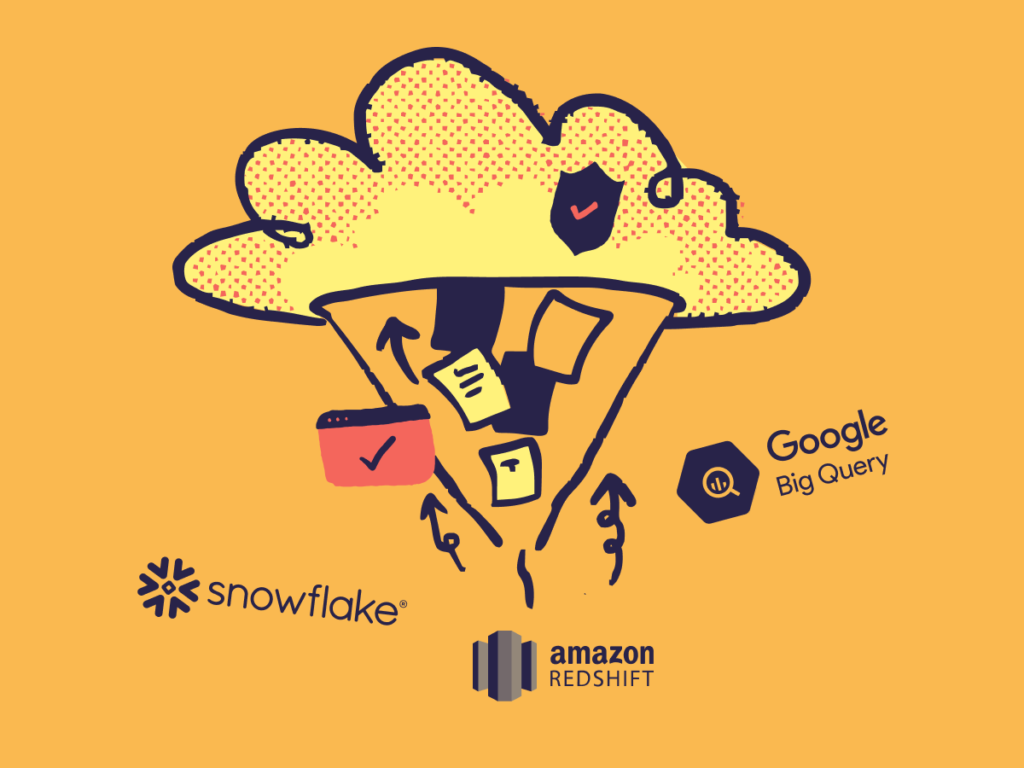
For those new to the concept, a data warehouse is a centralized database that stores a business’s critical analytics and reporting numbers. It’s an intentional “source of truth” that pulls numbers in from all over the business, cleans them, and organizes them so they’re fast and easy to query. Common data warehouses include Snowflake, Google BigQuery, Amazon Redshift, etc. Data warehouses are a favorite tool for mature data science teams who want to focus on precision and accuracy in reporting.
Examples of Common Data Warehouses

Benefits of Warehouse Native Experimentation
A main benefit of a warehouse native approach is that metrics get defined using the same “single source of truth” data as reporting and finance teams. That means experiment results neatly align with business intelligence (BI) dashboards and reports because they stem from the same source. For organizations with a mature data platform, this alignment saves a lot of time. It means fewer debates about metric definitions, and fewer number mismatches.
Another benefit of warehouse native is that your data stays within existing the security and governance boundaries of your warehouse. That means no user-level information gets sent to any third party for processing. This is especially important for businesses that adhere to SOC2 compliance, HIPPA requirements, and EU privacy regulations. Isolating your data in your warehouse means fewer vulnerabilities.
Bringing Down the Warehouse: Tradeoffs of Warehouse Native Experimentation
Though warehouse native systems bring a ton of useful precision for mature businesses, they also have pitfalls to consider. One of the biggest warehouse native issues is that data warehouses aren’t designed for ultra-low-latency interactions. (In other words: they’re not very fast.)
Data warehouses typically work by delivering experiment data in batches either on a schedule, or when specifically requested. These batches can take anywhere from fifteen minutes to 24 hours before you get visibility on what’s going on. For big businesses, this delay is a massive risk (with real world impact on your profit margins) that most data teams tend to overlook. That’s because the larger your company is, and the more transactions it processes per minute or second, the more you can lose by not monitoring your changes in real-time.
Another downside of a fully warehouse native approach is that your business shoulders the compute costs—not the experimentation platform provider. If your query performance isn’t efficient (e.g. scheduled regularly enough to be useful but not so often that it burns through your processing credits), then your warehouse events processing bill could balloon.
In short, a warehouse native approach gives you another budget item to track and manage. Conversely, with a cloud approach, the cost of computing results is included in your subscription contract, which makes your costs more predictable.
The point is, though warehouse native has a bunch of benefits, it also has problems you shouldn’t overlook. These are important tradeoffs that come with optimizing for data correctness and consistency over mitigating business risk with instant feedback.
A Balance Between Monitoring Speed and Reporting Accuracy
Data scientists, particularly those with academic backgrounds, learned to optimize for statistical rigor, correct results, minimal bias, and well-controlled conditions. And that instinct is valuable.
But in a commercial setting, a result that comes three days late isn’t just slow. It’s a decision without data, a rollback that didn’t happen fast enough, or a bad variant that ran longer than it should.
The right balance between speed and accuracy depends on the type of decision. For critical or hard-to-reverse changes, correctness matters more, and waiting is worth it. For most day-to-day product decisions, though, speed is usually underrated by less commercially minded people.
The point is that experiments don’t end when the analysis runs. They end with decision and action. Delays have a tangible cost to a business, and that cost belongs in the tradeoff calculation.
A Summary of Benefits and Tradeoffs Between Cloud and Warehouse Native Experimentation
The choice of experimentation architecture depends on your business’s specific needs, goals, and priorities. (Not to mention the culture of the team making the buying decision.) So, here’s a quick comparison table to help you decide which approach suits your business needs and team ethos best.
| Cloud Experimentation | Warehouse Native Experimentation | |
|---|---|---|
| Benefits | Quick and easy setup with less ongoing management. Provides real-time monitoring to protect profit margins. | Provides accurate, matching numbers that align with finance and BI reports. Data remains secure and isolated. |
| Trade-Offs | Potential for mismatching numbers between different “source of truth.” | Slow monitoring due to batch processing, which can lead to lost profits. Unpredictable computing costs. |
| Security & Governance | Data is sent to a third-party cloud for processing. May require additional auditing to ensure system alignment. | Data stays within your existing security boundaries. No user-level info is sent to third parties, simplifying compliance for SOC2, HIPAA, and GDPR. |
| Data Speed | Ultra-low-latency. Results and critical decisions surfaced in seconds. | Batch-processed. Visibility can take anywhere from 15 minutes to 24 hours. |
| Cost Structure | Predictable. Costs are bundled into a subscription. | Potential to balloon. Business shoulders compute costs, which can increase costs if queries are inefficient. |
ABsmartly Now Offers Warehouse Native
As of April 2026, ABsmartly customers can run experiment analysis directly in their own data warehouse while still benefiting from the ABsmartly platform. How? Well, the experiment assignment, experiment management, statistical analysis, and metric governance remain part of ABsmartly. But the experiment data and analysis stay inside your warehouse environment. That means your experiment results are computed in the same secure environment as the rest of your business’s data. ABsmartly’s new warehouse native experimentation is currently available for BigQuery, Snowflake, Clickhouse, Redshift, and Databricks.
Warehouse Native with ABsmartly

The Future of Experimentation Infrastructure: Secure, Accurate Data (Without the Costly Commercial Risk)
While full warehouse native experimentation support is a common request from potential (and even current) clients, this isn’t our vision of experimentation at ABsmartly. We don’t believe customers should have to pick a model and accept the limitations that come with it. When other experimentation platform providers give an “either/or” approach, we aim for the “yes, and…” to give experimenters the best of both worlds.

ABsmartly Gives You Speed and Rigor
Our Group Sequential Testing (GST) stats engine gives you the rigor of fixed-horizon testing and the speed of mSPRT fully sequential testing.
Hybrid Experimentation: Data Accuracy and Instant Monitoring
During our time building the experimentation platform at Booking.com, we’ve experienced first-hand the critical business role that real-time data plays in preventing profit loss and finding and fixing bugs. The platform at Booking started with real-time data only. Eventually, it evolved into hybrid model as the metrics became more complex and the governance needed to mature. Plus, we noticed that most organizations aren’t purely cloud-only or totally warehouse native after talking to many current and potential clients.
Modern businesses have teams that need real-time feedback alongside teams that need results anchored in warehouse data. And they have products that benefit from low-latency assignment and business units that will only trust numbers that come from their own systems. Forcing a choice between cloud and warehouse native means someone always loses. And at ABsmartly, we aim for the win-win.
Modern businesses have teams that need real-time feedback alongside teams that need results anchored in warehouse data.
Because we see the need for both approaches, we’re busy building a hybrid experimentation model. Our new approach will bring both managed cloud and warehouse native together into a single platform. That means you get cloud speed, real-time data, and simplicity where it makes sense. But you also benefit from warehouse consistency and governance where you need it.
No tradeoffs, no parallel setups. Just one single, robust approach.
More to come on our hybrid experimentation approach soon!
Get a demo to see how ABsmartly zigs when everyone else zags.
Written By

Get a Demo
Check out ABsmartly in Action
If you've outgrown basic experimentation tools and need to ramp things up, fill out this form. We'll contact you to schedule a product demo.